Zap Data Warehouse Automation
Automated governance → Flexibility and performance
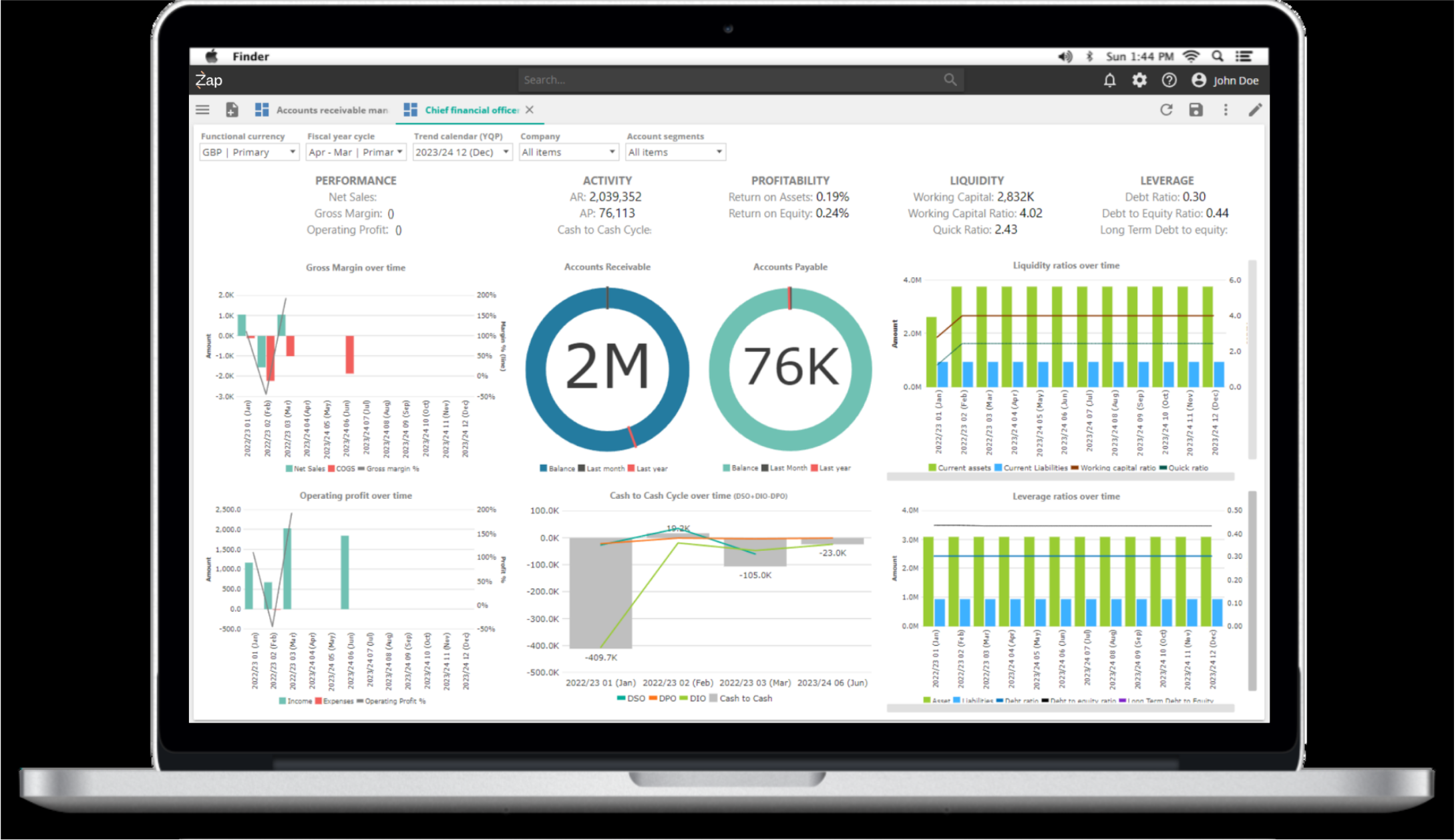
Zap Data Hub automates your ERP data warehouse, transforming scattered data into a single source of truth ready for reporting, analytics and AI. Pre-built models deliver insight in days, not months — with up to 80% less compute and refresh time and audit-ready data integrity built in.
Free 14-day trial with guided setup. We can loop in your partner when you're ready.
Request Free TrialSitting at the heart of a BI platform is the data warehouse, which hosts your enterprise models. It's a source of sanctioned data, as a system of record and as a hub, serving enterprise models for reporting, BI, and data science.Microsoft
The pillars of governance
Trust it
- Single source of truth
- Single source of meaning
- Single source of metrics
Secure it
- Secure platform
- Secure data
- Secure application
Respect it
- Personal data treatment
- Sovereign data treatment
- Industry data treatment
Why do I need a data warehouse?
A data warehouse provides data governance, centralizing your trusted, secure and compliant data. A synchronized analytic engine then provides context with rich names, descriptions and defined relationships. Zap Data Hub uses Azure SQL, an ACID-compliant data warehouse that enforces data integrity through structure.
Zap provides
What to expect
Faster insight
- Centralized context for a holistic understanding of your business.
- Smarter decisions via analytics and BI with visual insight.
- Gen-AI transforms for insight at machine speed and scale.
Trust and governance
- Single source of truth trusted, secure and compliant.
- Enforced integrity via keys, constraints and validation rules.
- Audit-ready with version history and native data lineage.
Replayable history
- As-of reporting on historical values with automated Delta records.
- SCD2 reporting on historical attributes with slowly changing dimensions.
- In-app revert to restore trusted versions for business continuity.
What we deliver
Synchronizing analytic engine
Mirror the star schema and sync refreshes to Power BI or Analysis Services automatically. Out of sync breaks trust.
Pre-built ERP data models and ERP smarts
Purpose-built models, star schemas optimized for ERP with ERP-aware transforms.
Intelligent data processing
Minimize refresh times and resource usage with smart detection of changed records and proprietary Delta processing.
Cross-platform data unification
Seamlessly combine ERP data with other business systems for complete visibility.
Enterprise versioning
In-app version tracking with history, rollback and full audit trails for governance.
Explore the Zap platform
Data Warehouse Automation, answered.
What does Zap Data Hub offer that we can't build with in-house data experts?
You can build it, but don't underestimate the effort. Most data experts aren't ERP experts. Zap ships the hard parts pre-built (ERP-tuned star-schema models) plus ERP-aware automation that keeps the analytic engine in sync, with governance baked in through enforced keys and versioning. The result is hours to first value, 80% less compute, more than 5x faster refreshes, and replayable history.
I only need improved reporting, is a warehouse overkill?
No. An automated warehouse stands up in under an hour and refreshes in minutes, even seconds. Even for reporting only, it protects your ERP from query load, keeps definitions consistent, and lays the foundation for future BI and AI.
How does Zap prevent duplicate records and ensure data integrity?
Power BI and OneLake can't enforce primary keys, so duplicates can corrupt financial reports silently. Even Fabric SQL Warehouse requires 'NOT ENFORCED' constraints. Zap uses Azure SQL Database (or SQL Database in Fabric) with enforced primary keys, catching duplicates before they reach a report. ERP financial data integrity is our specialty.
How exactly are your proprietary Delta refreshes faster?
Zap transforms each source change as two transactions: one reversing the original value, another adding the new value, like ledger adjustments. Synchronized to the analytic engine, this enables add-only processing and more than 5x faster refreshes, even for complex ERP data.
How does Zap ensure data security and compliance?
Zap safeguards data with enterprise-grade security across physical, operational and application layers. All customer data is hosted in SOC 2 and ISO/IEC 27001:2013 compliant Microsoft Azure data centers. See our Cloud Security page for detail.
What deployment options does Zap Data Hub provide?
Zap Data Hub is a cloud-only, fully managed platform, with no infrastructure to install, patch or maintain. It connects securely to your data wherever it lives, cloud or on-premise, so your existing sources stay in place while Zap runs in the cloud.
Talk data to us.
Getting started is easy. We're with you every step of the way, with in-app training, dedicated support and a global team committed to your data transformation.